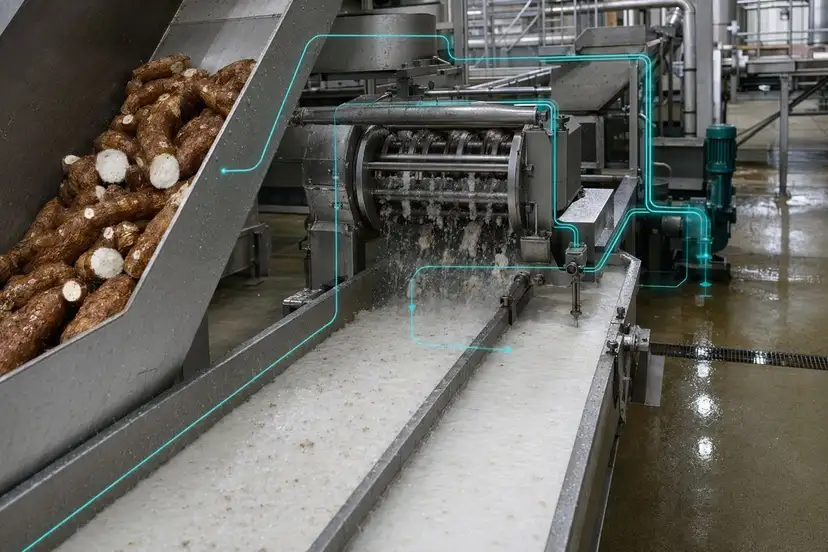
Reducing Cassava Starch Wastewater Load Without Slowing Production
Practical enzyme strategy for cassava starch factories aiming to reduce organic load, improve separation behavior, and protect throughput under variable root quality.
Request pricing Practical enzyme strategy for cassava starch factories aiming to reduce organic load, improve separation behavior, and protect throughput under variable root quality.
Request pricingCassava starch wastewater is not just a treatment-plant problem. It is a process-control signal.
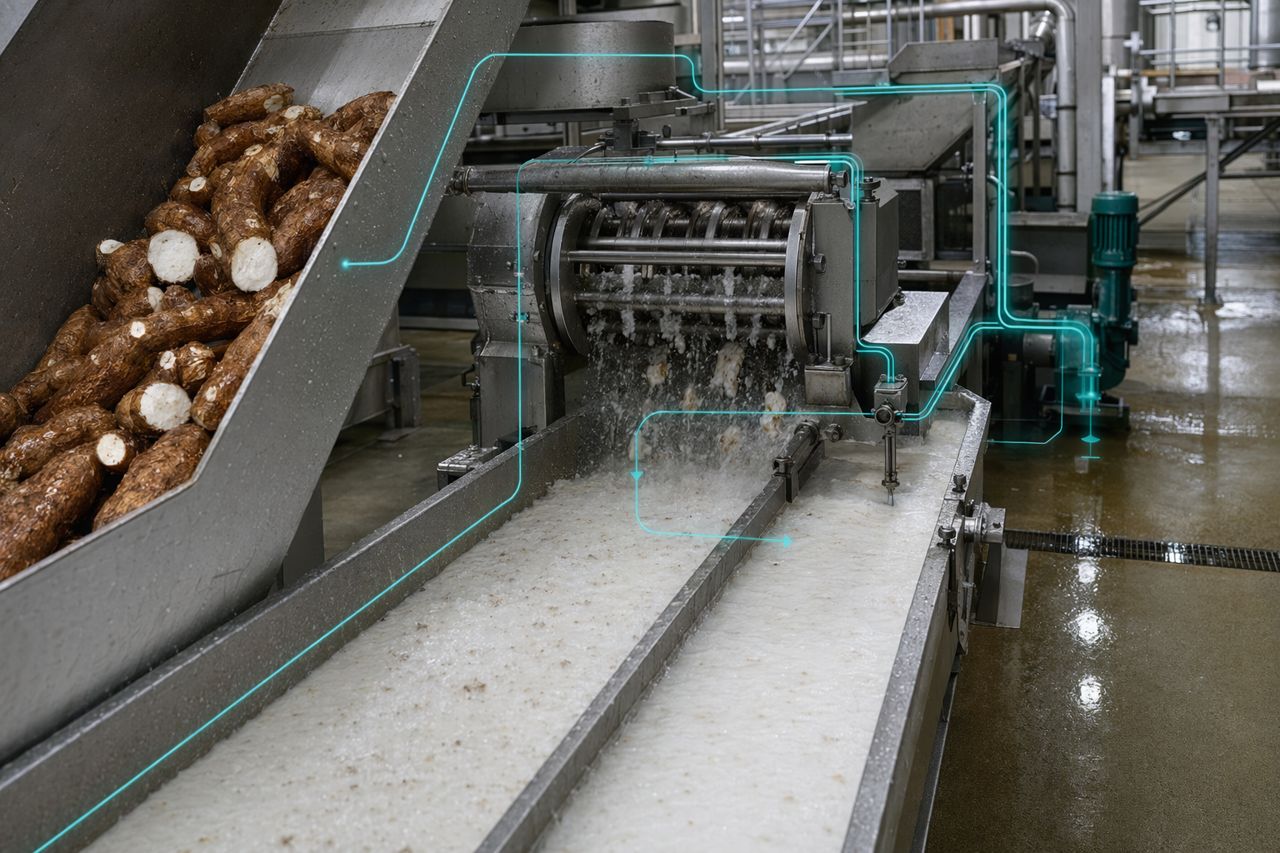
When root quality shifts, rasping becomes inconsistent, fiber breaks finer than expected, slurry gets harder to separate, and more soluble organic material reports to the wastewater stream. The result is familiar to plant teams: higher load to treatment, unstable settling, more odor risk, more chemical pressure, and a daily argument between throughput and discharge discipline.
A practical enzyme program can help reduce that tension. Used correctly, enzymes support cleaner slurry behavior upstream so fewer troublesome organics carry forward into wastewater. The goal is not to slow the factory down. The goal is to keep the line moving while sending a more manageable load to the back end.
For plants evaluating an enzyme supplier for cassava starch processing, wastewater load reduction should be discussed as a whole-process target, not as a stand-alone additive trial.
In cassava starch production, organic load builds across several points:
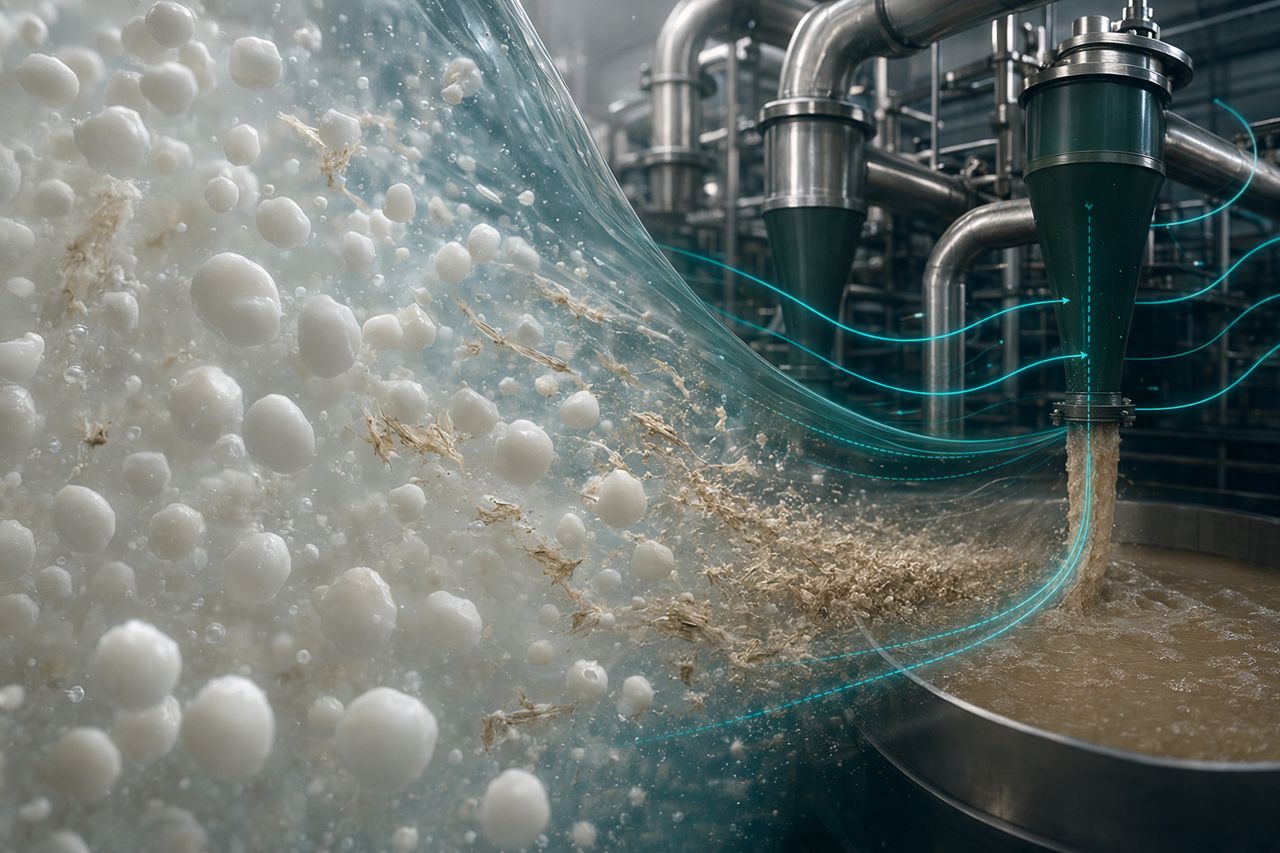
A treatment plant sees the final burden, but the burden is shaped much earlier. Fine fiber, cell-wall fragments, soluble pectin-rich material, residual starch losses, and unstable slurry viscosity all affect how much organic matter leaves the extraction process.
If the front-end slurry is difficult to separate, the wastewater system pays for it.
The right enzyme approach targets non-starch polysaccharides and cell-wall materials that interfere with separation and water clarity. In practical plant language, the desired outcomes are:
This is where dose discipline matters. Over-treatment wastes money and can create process noise. Under-treatment turns the program into a purchase order with no operational impact. A good supplier should help define a dose window that fits your residence time, temperature range, slurry consistency, and production rhythm.
Wastewater improvement cannot come at the cost of production rate. Cassava starch factories run on uptime, not laboratory ideals.
A serious enzyme program should therefore be evaluated against plant-floor questions:
| Plant concern | What to check during an enzyme trial |
|---|---|
| Feed variability | Does performance hold across fresh, mature, and mixed root lots? |
| Slurry behavior | Does viscosity become easier to manage without slowing flow? |
| Separation load | Are screens, centrifuges, and hydrocyclones seeing less stress? |
| Starch recovery | Is brightness and recovery protected while wastewater load drops? |
| Treatment stability | Are peaks in organic load reduced, not just shifted later? |
| Cost control | Is the dose practical for full-scale daily operation? |
The strongest result is not a single good sample. It is a calmer process over multiple production days.
Before starting, align plant, quality, wastewater, and procurement teams on the baseline. Otherwise, the trial becomes subjective.
Useful operating markers include:
The key is to evaluate the enzyme where it creates value: not only at the dosing point, but across extraction, separation, and effluent management.
For a cassava starch factory, enzyme procurement is not just price comparison. It is operating risk management.
The supplier should understand seasonal root variation, wet extraction constraints, sanitation realities, storage conditions, and the need for predictable deliveries. A low-cost product that arrives late, requires constant dose changes, or lacks technical support can erase its savings quickly.
ManiFlow Catalytics works as an enzyme supplier for cassava starch processing with a practical focus: stable production, controlled slurry behavior, cleaner separation, and lower wastewater burden without asking your plant to sacrifice throughput.
A disciplined plant trial does not need to disrupt production. It should be simple enough for operators to run and clear enough for management to trust.
Decide whether the main goal is lower organic load, better separation, lower starch loss, improved slurry handling, or a combination. Wastewater reduction is usually strongest when paired with separation improvement.
Dosing should happen where contact time and mixing are real, not theoretical. The best point depends on your root preparation, rasping layout, dilution water, and downstream separation equipment.
Run long enough to see root variability. A short trial during an unusually stable feed period can make any solution look better than it is.
If the wastewater load improves but starch recovery drops, the program is not acceptable. If starch recovery improves but wastewater peaks remain unchanged, the dose strategy may need adjustment.
Before scale-up, confirm packaging, shelf-life expectations, storage requirements, lead time, documentation, and support availability. Reliability is part of the technical solution.
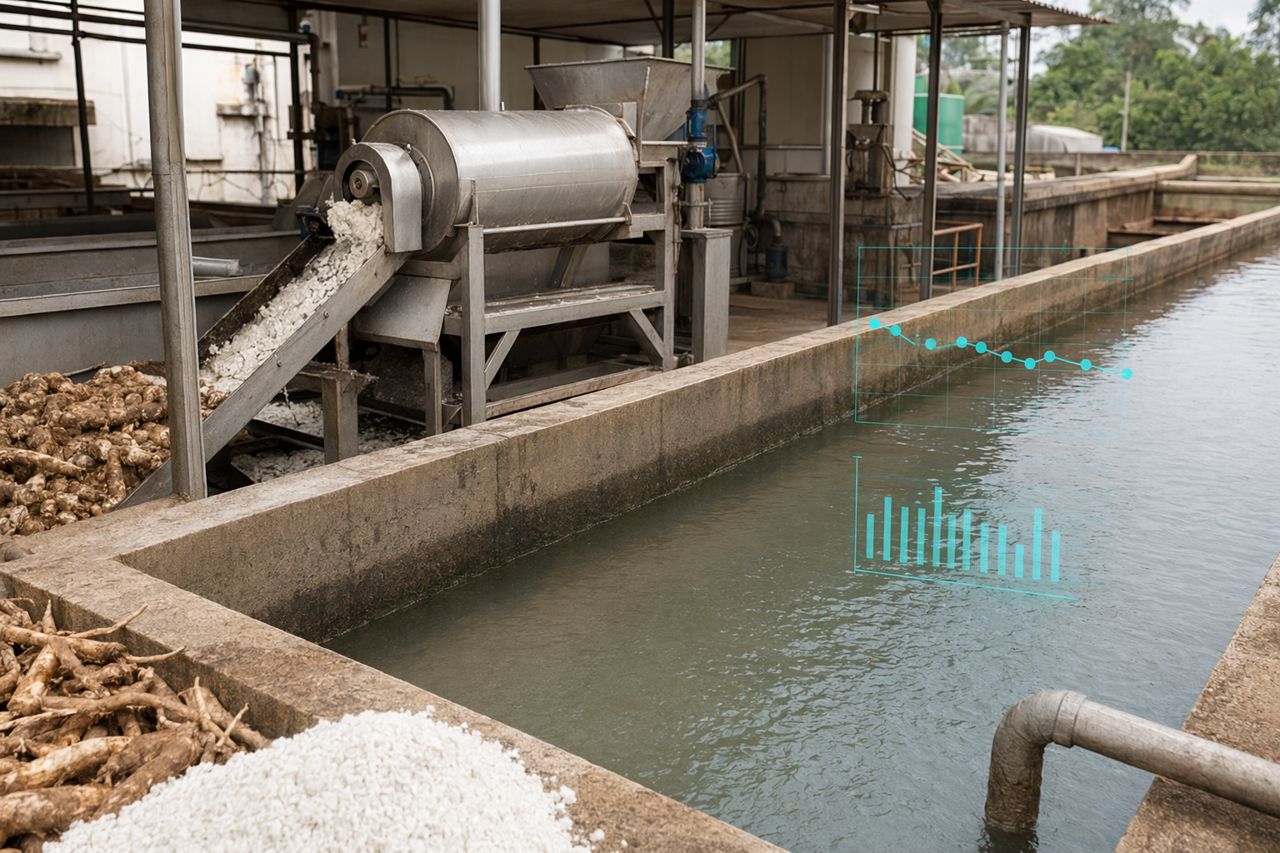
Reducing cassava starch wastewater load starts before the effluent tank. It starts with how the root structure breaks down, how slurry moves, how starch separates, and how consistently the process responds to variable raw material.
With the right enzyme program, plants can lower the organic burden sent to treatment while protecting production speed and starch quality. That is the practical target: cleaner water load, steady throughput, and fewer surprises at the end of the line.
Ready to evaluate a fit for your factory conditions? Request a quote and share your process goals, root profile, and current wastewater challenge.
Tell us your application and volume — we reply with pricing and lead time.